In 1991 The Windhoek Declaration reported that “the worldwide trend towards democracy and freedom of information and expression is a fundamental contribution to the fulfilment of human aspirations”. Human aspirations, such as what, however?
Feminists all over the world might argue that these wishes are the respect of basic human rights, in accordance with a gender equality for a long time aimed. Gender and human rights activists are watching carefully what is happening in Iran since the death of Masha Amini the past September, observing a strong push towards a more progressive life. The same is happening in Afghanistan, where the focus of numerous activists is addressed, in view of the denial of access to education to women.
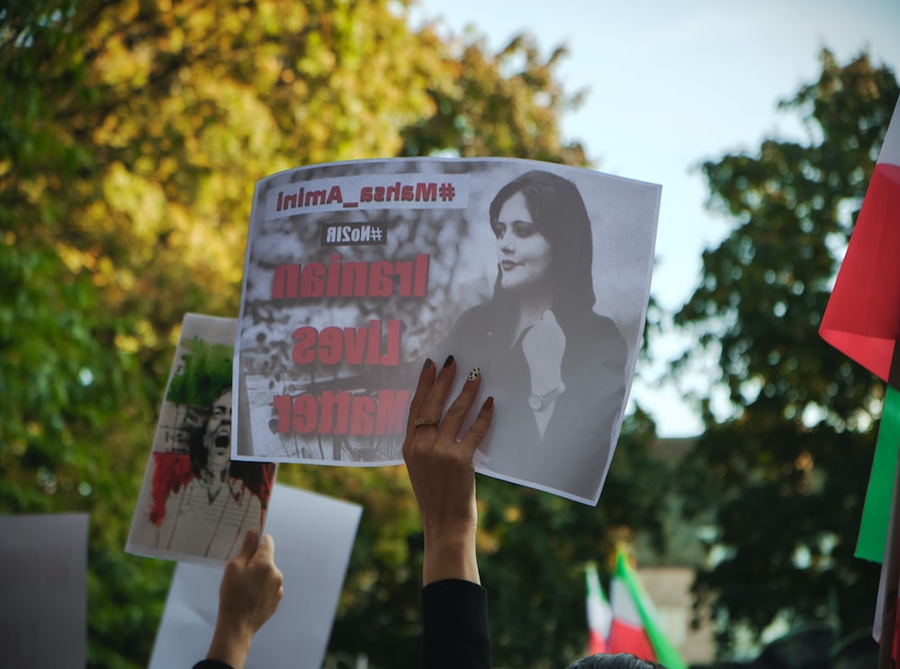
People are finally talking openly about gender difficulties and human rights all over the world and there is always one main component in common: direct news are coming from people. In this scenario we are not talking about professional journalists but ordinary people, using the cameras in their phone and their words to document what their own eyes capture: we are talking about citizen journalists.
This setting allows the use of journalism as a public good[1], with the involvement of the audience not only as recipient of information but as subject of the communication chain.
This way of sharing news is not new to the mediatic scene, but for sure its use in a feminist context might result in innovative contributions: it could shift gender scripts not only from a cultural perspective, but also from a mass communication point of view.
In order to better understand this phenomenon, however, it is necessary to take a step back and go back to basics. It is essential to analyse the roots of an abstract arena where ideas can be shared freely by everyone, in name of democracy, despite regimes, religions or other entities. This same place, called Public Sphere[2], works as an intermediary between people and institutionalised powers, acting as a watchdog of democracy[3].
From the skilled use of rhetoric made by the Sophists in Athens to the exercise of dialectic by the Catholic propaganda during the crusades[4], the use of discourse has always been extremely clear: language, and then media, have been associated with power, and, more specifically, to the application of power in a hierarchical structure shaping minds and, consequently, realities.
It is in this context that, in the 18th century, the emerging bourgeoisie understood the importance of an agora where ideas can be shared independently from higher institutions. In fact, this worked as an abstract space where those same positions could be challenged and questioned2.
The private and public become finally separated entities: the community is entitled to make their intimate decisions, working on its cultural and personal education
However, despite its success, something changed along the way: Habermas described it as refeudalization2, in which the much declaimed independency of the bourgeoisie and its ideas merges again with a feudal structure of power.
Public and State, private and society blend in function of a more profitable and capitalistic aspect of knowledge and information. In this scenario, media lose the essential role of watchdog of the democracy, endangering the idea and application of democracy itself.
The return to a communication subjected to games of power led, unequivocally, to a decline of a democracy intended as a shared experience in whose arena every word carries weight. Information became remarkably part of the capitalistic factor, and the commodification of knowledge is simply another of its elements.
From an academic point of view, what theorised and explained up to now is clear and absolutely reasonable; however, from a feminist perspective, there is a remarkable problem. One of the main critiques formulated to Habermas’s theory, in fact, is that minorities were not taken into consideration[5]; the possibility of being part of the public sphere were circumscribed to white and middle-class men. It is pure academic, and this is the field, for excellence, where the role of white, middle-class men is predominant: the colonisation of academia made hard an inclusive and intersectional approach.
On a more optimistic side, we have finally the opportunity to be part of this scene and use the public sphere to communicate in first person, without a patriarchy based filter.
But in concrete, how did we started being able to do it? In a nutshell there are some ways that are in the making. The decline of the traditional public sphere towards a more interactive and transnational concept of “Blogosphere”[6] makes, with no doubts, feminism activism easier.
Martin Seeliger7, social scientist, claims that the new public sphere is in development restarting from 3 principles: digitalisation, globalisation and commodification. These structural changes in the agora of communication lead to a new approach of the divulgation of news, becoming on one side more accessible and on the other one more personalised.
Social Media and the digitalisation of the public sphere[7] have changed the nature of the sphere itself: Baartur and Aggarwal, in 2021, claimed “the frictions in this unstable communicative space have particularly impacted how gender justice issues break into public consciousness, how they are constructed, deliberated, and progressed upon”.
Peripheral positions can finally find their place in the mainstream area, also relying on the new ways in which communication is done.
The personalisation of the public sphere allowed an introspection of the society from a feminist point of view. This lens would allow an understanding of gender issues that is innovative as well as traditional, dealing with matters gender related that exist since the night of times but in an innovative way.
Judith Butler claims the importance of understanding gender and social vulnerability in order to overcome them: “It would seem that without being able to think about vulnerability, we cannot think about resistance, and that by thinking about resistance, we are already underway, dismantling the resistance to vulnerability in order precisely to resist”5.
In this context, an alternative approach to journalism and news takes place, becoming fertile ground for citizen journalists.
Citizen journalism allows the creation of a new demos in a new agora, made of freedom of speech, autonomy and, in this scenario, new activism.
This newfound feminist advocacy, that hopefully will continue more and more often to ride the wave of an intersectional approach, is done online, by people that most of the time are not part of the conventional academic environment.
Nisha Chittal knew that very well when, in 2015, wrote that the strongest weapon in this arena is a hashtag: #bringbackourgirls, #changetheratio and #yessallwomen are only some of them, not to mention the legendary #metoo.
Prof. Kebble, professor of Journalism in the University of Cardiff, explained clearly the role of alternative journalism: “we need as both academics and citizens to move away from the concept of the audience as a passive consumer of a professional product to seeing the audience as producers of their own (written or visual) media”.
From this perspective, citizen journalists assume the role of proper activists, finding their place outside the comfort zone of an editorial line or external pressures.
One of the main examples can be found in the Arab Spring, cultural revolution started in the early 2010s following a rebellion started in Tunisia. This cultural revolution spread quickly also in other North African countries, such as Egypt and Libya, with different outcomes.
A strong role has been played by alternative journalists, allowing a communication honest and peer-to-peer between the community. This cyberactivism allowed the internet to help and support a political shift, moving the political scenario onto a cyber ground.
This same ground was populated by women looking for their rights to be embraced. Asmaa Mahfouz, for example, played an essential role online, reclaiming a cultural environment and public sphere free from gender restrictions.
At the same time, the shift to an online fight and the digitalization of the public sphere helped also from a practical point of view: it makes, in fact, the authors themselves less reachable and helping the communication between different units of activists.
The same pattern can be found in the more recent Iranian rebellions. The death of Jina ‘Mahsa’ Amini in September ’22 has become viral following the share of her images in the hospital after her arrest by hand of the “morality police”.
The global distribution of those images and the repost by women from all over the world, is shaking the regime in Tehran. Sarvenaz Ahmadi, Maryam Vahidian and other dozens of journalists put their life at stake to communicate using channels not approved by the Iranian government to divulgate the reality they live in.
The spark that has been lit in September became quickly a huge fire, inducing the involvement of not only journalists: activists, important personalities and NGOs worldwide support the rebirth of Iranian women and a cultural revolution.
However, despite this work being supported by major NGOs, it does not mean that these journalists are not in danger. If anything, the risks can be even bigger as communicating what the institutionalised channels would not allow.
Only in the first 2 months following the beginning of the riots, 46 citizen reporters had been jailed, especially using the internet, with numbers that drastically increased since then. However accurate numbers are difficult to detect due to the issues in engaging with official sources about same.
In this context, citizen journalism is able to provide a new unconventional and non-academic lens. Undeniably, this type of journalism has controversies, but at the same time, in specific environment, is the only glimmer of access into a public sphere where human and feminist rights are discussed.
As mentioned, the role of citizen journalists is still defined as controversial as not completely regulated, mostly online and on social media, where the regulation matter is even a thornier issue. However it is undeniable that this kind of communication can arrive in places where conventional channels are not allowed to.
This ability allows alternative journalism to open the gate to a new approach to reality through a gender lens that becomes political and inclusive, open to the whole population. Judith Butler claims: “Who is included in the ‘demos’? Who was never part of the people, but always part of its lining, or its defining other? We have yet to think through the question of the ‘who’ in politics”5.
We can continue to deny it until the end of the day, but the world we live in has been in men-proof for centuries, the demos considered until now has been predominantly masculine: an unconventional journalistic voice is the frontier of a new feminist activism.
Alternative communication allows a more inclusive one, involving a more accessible role as “subject” in the surrounding environment.
It is our duty, as feminists, to support a change in communication: if on one side, journalism is reshaping itself in order to find a collocation in a new public sphere, on the other side it is creating a completely new reality where those same innovative expressions can become the standard.
Citizen journalists apply their abilities to a number of different fields, from pure entertainment to sensational and investigative reports; however, applied to the feminist fight, they assume a new and strong role as dynamic activists.
In an era where the line between private and public is blurred and where human rights fights are the order the day, being an activist takes courage. The action of a journalism that works behind the scenes and beyond the borders cannot be underestimated.
[1] UNESCO. (2022) Journalism Is a Public Good: World Trends in Freedom of Expression and Media Development. Paris: UNESCO.
[2] Habermas, J.(1991): “The public sphere” In Mukerji, C.; Schudson, M.(Ed.): Rethinking popular culture. Contemporary perspectives in cultural studies. Berkeley/Los Angeles: University of California Press
[3] Curran, J. and Gurrevitch, M. (eds.) (2005) Mass Media and Society. 4th ed. London : New York: Hodder Arnold ; Distributed in the U.S.A by Oxford University Press.
[4] Bates, D. (2006) ‘Public Relations from the Dawn of Civilization’. p. 27.
[5] Seeliger, M. and Villa Braslavsky, P.-I. (2022) ‘Reflections on the Contemporary Public Sphere: An Interview with Judith Butler’. Theory, Culture & Society, 39(4), pp. 67–74. DOI: 10.1177/02632764211066260.
[6] Iosifidis, P. and Wheeler, M. (2016) Public Spheres and Mediated Social Networks in the Western Context and Beyond. London: Palgrave Macmillan UK DOI: 10.1057/978-1-137-41030-6.
[7] Seeliger, M. and Sevignani, S. (2022) ‘A New Structural Transformation of the Public Sphere? An Introduction’. Theory, Culture & Society, 39(4), pp. 3–16. DOI: 10.1177/02632764221109439.
 Stefania Del Sette
Leave a comment